In his rich and distinguished career as an author, museum educator, and radio commentator, Richard has written hundreds of science, art, and education pieces exploring a broad and diverse field of topics, ranging from mummies to Nelson Mandela, to Inuit dialects and the Silurian reefs of the upper Midwest, among many others. These pieces include essays, broadcast commentary, voice-over narration and video scripts, education and visitor engagement programming material. This writing reflects a vast array of comprehensive knowledge in science, culture, and the humanities.
Following are excerpts from Richard’s prose writing in these fields.
EDUCATIONAL TEXT: David & Goliath—How it Really Went Down: The World’s Best—and Perhaps Only—Sling Stone Story
From the special exhibition: Weapons—Beyond the Blade, Milwaukee Public Museum, Fall 2017
According to the Old Testament Book of Samuel, back in the early 11th century or so BCE Saul, King of the Israelites, lead his army in battle against the Philistines, an aggressive, warmongering tribe to the southwest. The Philistine champion is Goliath, a giant of a man, a brute and renowned as invincible. Some ancient sources have him at six feet, nine inches, while others describe him as well north of nine feet. Either way, he’s an awful lot bigger than David. About eight times bigger. Every day, Goliath taunts the Israelites, challenging them to send out a champion of their own to fight him in single combat and decide the outcome of the battle. No one’s interested.
A young shepherd boy, David, hears about this—and of the reward Saul promises to whoever defeats Goliath—and accepts the challenge. Saul, perhaps feeling a bit shamed at this point, offers David his armor, but David turns him down. He has other ideas.
David and Goliath confront each other. Goliath wears armor, and carries a sword and javelin. David has his staff and sling and five stones from a nearby stream. (Doesn’t seem like much against all that metal.) David gives Goliath a severe dressing down in the name of the Lord, at which the giant has a good laugh for himself. David hurls a stone from his sling and hits Goliath square in the center of the forehead, inflicting what we might call a career-ending injury. Goliath falls to the ground dead, and David cuts off his head. Problem solved. Battle won. Go Israelites.
Here, Goliath commits the classic blunder of basically bringing a knife to a gunfight. Goliath thinks he’s going to stomp the shepherd’s guts out, but David’s not having it. He knows that in the hands of a skilled slinger, which he is, a well-slung stone will do an awful lot of damage, traveling as it may at about 130 miles an hour, or 190 feet per second. That’s not as fast as a bullet, but it’s fast enough. Goliath didn’t have a chance. David, we might say, rocked it.
VIDEO SCRIPT: The Language of Snow
Milwaukee Public Museum, 2018
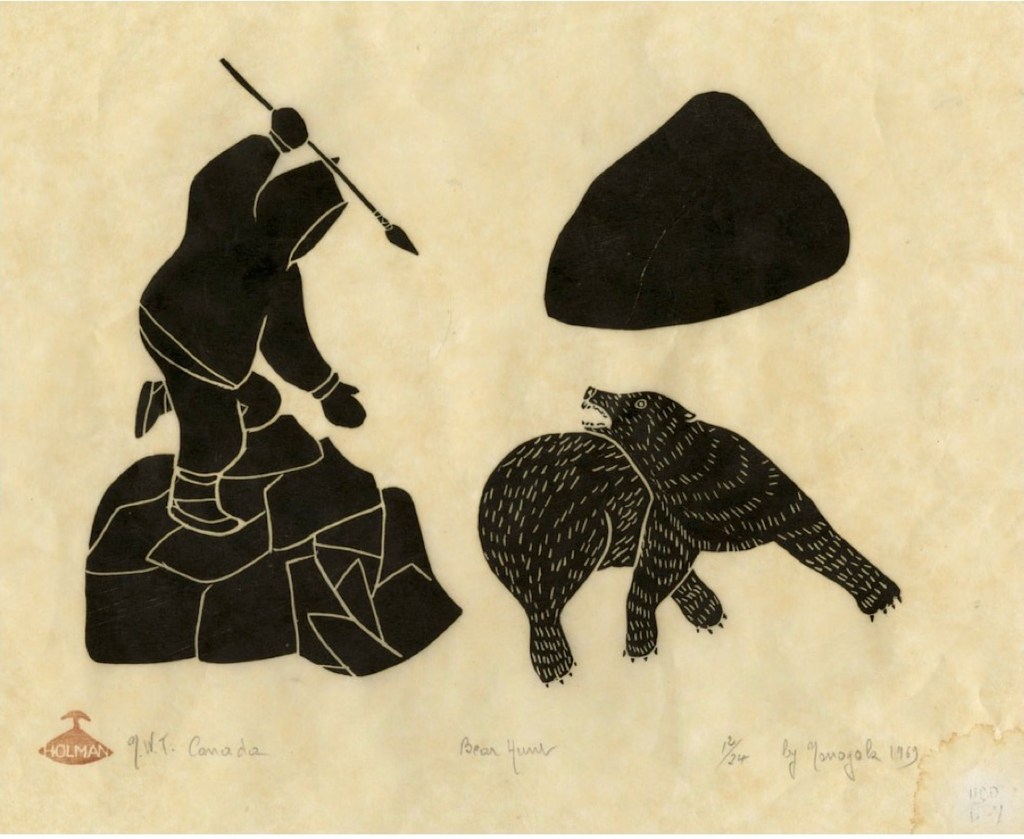
It is often said that the Inuit—one of several indigenous peoples of the Arctic circle—have a hundred or more words for snow. Is this actually true? Well, sort of.
In fact, among the people of these many nations, there are likely more than 100 words for snow–and ice, and sea ice–as well. Some estimates put it closer to 200 words.
According to the Museum’s anthropologist, this is not a myth. That said, most Sub-Arctic and Arctic cultures don’t have more than a few dozen words altogether. So, while it’s true that there are hundreds of words for snow among these people, in fact, they generally derive from multiple languages and dialects.
This kind of linguistic complexity should come as no surprise. For us Wisconsinites, snow is a part of life for a few months out of the year. Arctic people do more than live with it, they live on it, and snow and ice are practically a way of life, pretty much all the time.
So, this gives us an idea of how important these things are for the Inuit, and the way they communicate with each other about it can be a matter of life and death. They need to know whether ice and snow is fit to travel over, or whether you’re going to sink through it.
The language of both the Inuit and Yupik people has generated many dialects. Early 20th century scholars only recorded a small fragment of these words, and in the intervening century, much has been lost. Originally there would have been many more such terms than there are today.
For many of these dialects, the vocabulary associated with sea ice is even richer. In the Inupiaq dialect of Wales, Alaska, one anthropologist documented approximately 70 terms for ice such as utuqaq, which is ice that lasts year after year, and auniq, which is ice filled with holes, like Swiss cheese. Yet another term refers to the patchwork layer of crystals that forms as the sea begins to freeze over.
The Sami people, who have lived for millennia in the remote northern reaches of Scandinavia and Russia, use at least 180 words related to snow and ice. The Sami are historically a reindeer people, and have as many as one thousand words for them. These refer to such things as the reindeer’s fitness, personality, and the shape of its antlers. The word snarri, for example, is a reindeer whose antlers are short and branched.
All language finds a way to say what its speakers need to say, and it’s the force and precision these words bear that’s most vital, rather than a debate about how many there are. So, we can see language as a rich and compelling tool for learning about the people who speak it.
For example, we Americans have multiple words in English for something that’s vitally central in our culture, something we tend to be known for in other countries around the globe. Any guesses? How about money?
By one calculation, there are close to 100 words for money in the English language. How many words for money do you imagine can be found in the language of indigenous Arctic people? Probably not too many. Traditionally, these people had no word for it.
EDUCATION BACKGROUND: Netsuke—Mastery in Miniature
Milwaukee Public Museum, March 2023
Most of us are likely familiar with the kimono, the traditional Japanese garment. Derived from the words ki, meaning “wear,” and mono meaning “thing,” they are typically hand-sewn into a T shape from four single pieces of fabric and fastened with a sash called an obi. In its simplicity, the kimono leaves no room for one particular feature that no one today could quite do without: pockets. But, as with so many things, this problem became an opportunity.
The solution emerged over four hundred years ago during the Edo period when Japan experienced its first period of extended peace in nearly 500 years. During the Edo era, Japan saw a higher standard of living, accompanied by increased agricultural development, education and literacy, prosperity, and a blossoming of artisanal craftsmanship.
To compensate for the lack of pockets in kimono, women stashed personal items in their sleeves, but men began wearing sagemono. Originally worn by men of the warrior class, sagemono are small cases or pouches suspended from the obi, making it easy to carry small objects such as seals, pipes, coins, writing implements, and materials like medicine and tobacco.
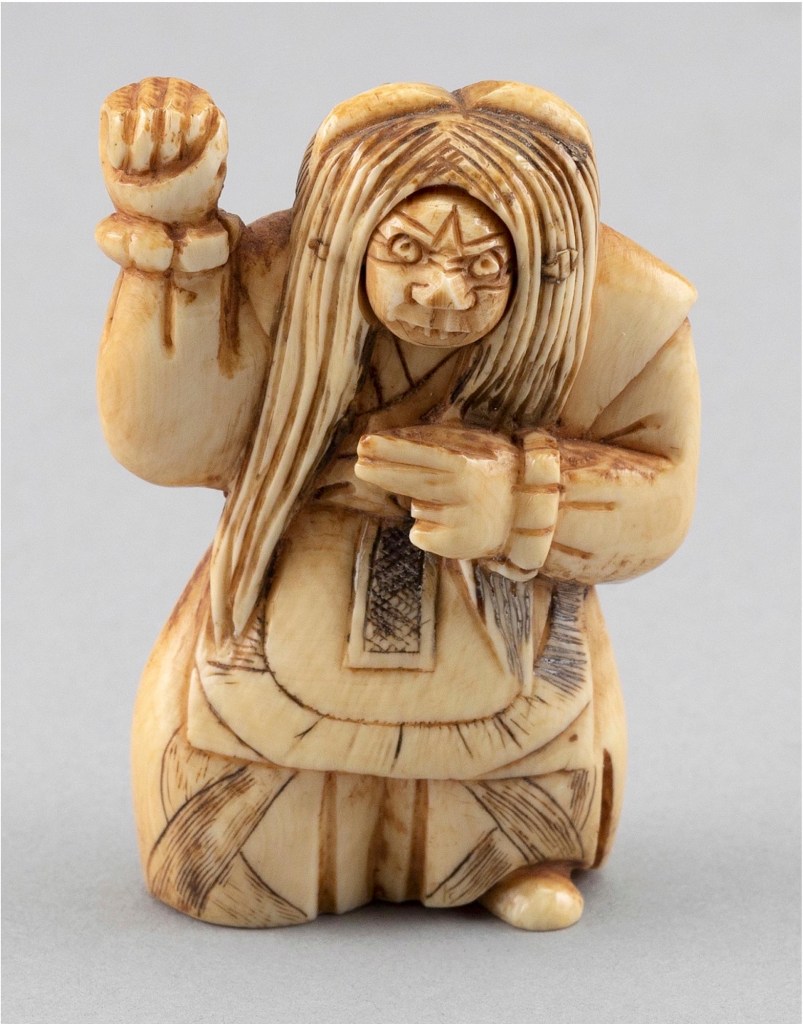
A cord, or himo, attached to the sagemono, was tucked inside the obi and anchored by small, elaborately carved fob-like object that served as counterweight, preventing the himo from slipping through. These objects are called netsuke, and they are extraordinary.
The first netsuke were made of small, dried gourds, slender pieces of wood or bamboo, reflected in the way netsuke is written in Japanese, with two characters meaning “root” and “attached.” Netsuke also commonly have two holes through which the cord is threaded to connect it to the sagemono.
Japanese craftspeople turned netsuke into stunning, diminutive works of art reflecting naturally found objects, plants and animals, heroes and beasts of legend and myth, gods, religious symbols, daily activities, theatrical masks, and historical, literary or everyday figures, and myriad other themes. Some were considered talismans and ascribed with religious or magical powers intended to protect or heal.
Usually carved from such materials as wood, ivory, shell, tagua nut, and horn, among others, netsuke became a fixture of the Edo period. They generally ranged from about the size of a walnut to perhaps a golf ball, and were commonly carved to a smooth finish so as not to snag the silk fabric of the kimono. Over time, their design grew increasingly intricate, whimsical, and masterfully carved, displaying an astonishing range of styles and themes. Small and inconspicuous, netsuke encapsulated the refined aesthetic sense and subdued elegance of the Edo-period. Eventually worn by men of all levels of society, netsuke became particularly fashionable among the Edo period merchant class.
By the mid-eighteenth century, however, new customs of dress had evolved, and netsuke gradually fell out of fashion, though some were still produced for the tourist trade. Today, netsuke are carved for collectors in a broad range of styles, and are highly coveted as collectible fine art objects, and several netsuke organizations hold conferences and gatherings in locations worldwide.
After more than 400 years, Netsuke still continue to intrigue and dazzle us, having evolved from simple, practical objects into captivating and intricate carvings admired and collected worldwide.
ESSAY: Mummies
Broadcast commentary, Lake Effect, WUWM FM, NPR affiliate, Milwaukee, October 2018
Over the years, the Milwaukee Public Museum’s visitors have found our mummies to be a source of enduring curiosity. And this is not surprising. Since the beginning, mummies have been objects of fascination and considerable misadventure.
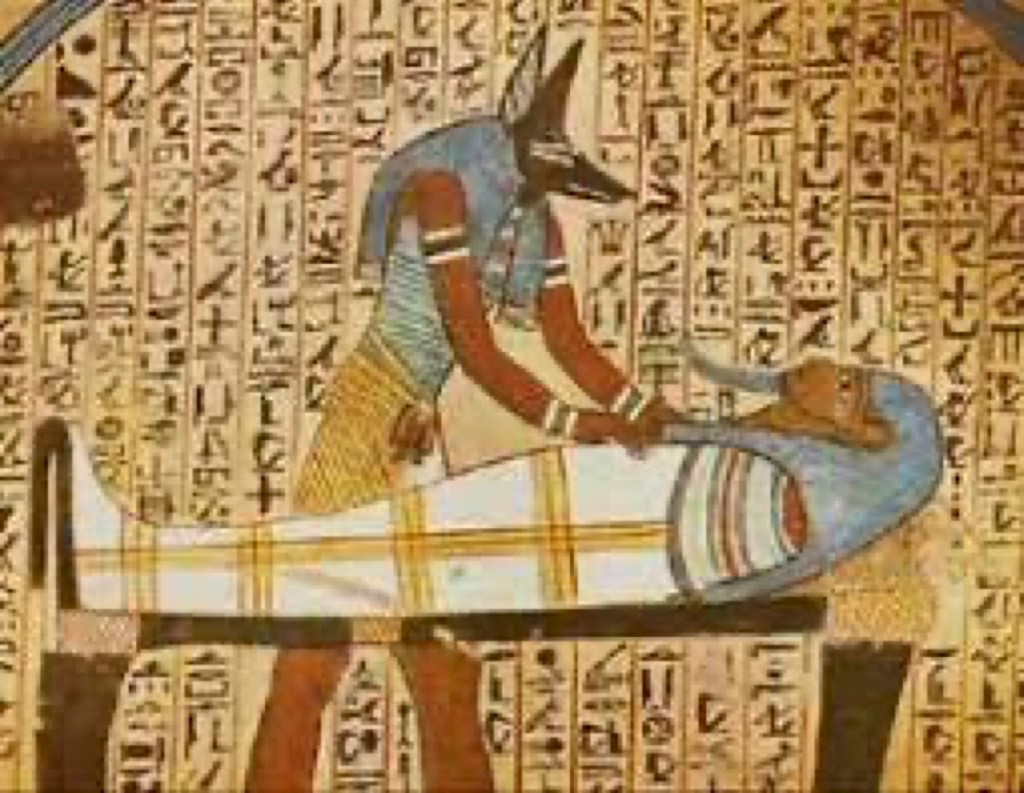
Ancient people all over the globe mummified their dead. In fact, the Egyptians were not even the first to do it. That was likely the Chinchorro people of what we now know as Chile and Peru. They were mummifying their dead in the dry air of the coastal desert about three thousand years before the Egyptians even thought about it. But the Egyptians were the virtuosos, and a well-preserved mummy from ancient Egypt is a master work of the form.
Napoleon knew this, and sent mummies back to France during his disastrous military campaign in Egypt in the late 18th century, generating our modern interest in them. By the mid 19th century, mummies were trending. Very much a thing to have if you wished to project an air of cultural adventurism, many well-to-do Europeans brought mummies back from Egypt or sent for them. It was common to hold “unrollings,” as they were called, where guests were invited to watch as the mummy was unwrapped—or “unrolled”—just out of curiosity, just to see what they looked like under the bandages.
A source of enduring mystery, mummies have long been thought to bear a powerful life force. Since at least the Middle Ages, apothecaries ground mummies into powder which, added to various concoctions, were cheerfully peddled as miracle cures well into the 19th century. A kind of snake oil, if you will, it may have made up in morbid curiosity what it utterly lacked in potency. It was, of course, useless.
 Richard Hedderman